“Cracking the Crab: Russian Espionage Against Japan from Peter the Great to Richard Sorge” by James D.J Brown
Did a forged document created in the late 1920s influence America’s decision to use nuclear weapons against Japan? Quite possibly so, in the view of author James D.J Brown.
The “Tanaka Memorial” (memorial meaning a formal report to the Emperor) was supposedly written by then-Prime Minister Giichi Tanaka. In it was laid out a Hitlerian plan for world domination: “to conquer China, first Japan must conquer Manchuria-Mongolia. To conquer the world, Japan must first conquer China.”
As Brown informs us, no Japanese language version was ever found, and the Chinese version that circulated overseas contained simple errors of fact and rough locutions unlikely to be used by Tanaka. Nonetheless, few outside Japan questioned its authenticity. Indeed, in today’s Russia it is still taught at school as if it were an unimpeachable historical document. As to the identity of the real author, opinion is split between the Soviet intelligence service and Chinese Nationalists.
At the time, it was Soviet policy to incite friction and, if possible, war, between Japan and the U.S. The Tanaka Memorial was a superb propaganda weapon when translated into English and disseminated by Soviet front organisations in America. A rear-Admiral testified to Congress that it was authentic and it even appeared in Frank Capra’s 1944 propaganda movie “Know Your Enemy – Japan.”
Brown sums up. “The Tanaka Memorial therefore had a major impact on how Americans understood the war. It reinforced the view that the attack on Pearl Harbour was a part of a premeditated plan, and not an act of desperation taken by Japan as it sought to break the ring of containment and retain territorial gains in China.”
The author is British and a Professor of Political Science at Temple University. Well versed in both the Japanese and Russian languages, he decided to write a non-academic book that would appeal to intelligent readers of all kinds. He succeeds brilliantly, examining the wary relationship between the two countries through the lens of espionage.
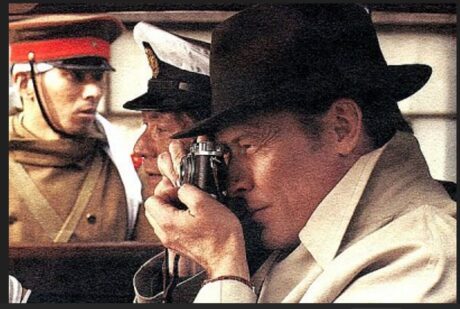
Sorge; from the excellent film by Masahiro Shinoda
The title is taken from a comment from Richard Sorge, the master-spy who worked for Soviet intelligence in Tokyo until he was finally exposed in 1941 and executed in 1944. Sorge’s view was that Japan was a tough target for espionage because, like a crab it has a hard carapace in the form of an insular culture born of long isolation. Yet once that defensive shield is pierced, the institutional checks are non-existent, allowing the wily spy to gorge on the soft flesh of secret information.
Brown’s book ends in 1945 but the author has promised a follow-up volume covering the post-war period. It should make equally fascinating reading. Until the Abe reforms of 2014, there were effectively no penalties for spying or handing classified material to foreign powers. In the words of former Prime Minister Nakasone, Japan had become “a paradise for spies”.
That was no exaggeration as was clear from the testimony of Stanislav Levchenko, a KGB major working in the guise of a journalist in Tokyo. Levchenko defected to the U.S. in 1979 and revealed 200 names of Japanese agents, including many significant figures such as the head of the Socialist Party.
It took another 30 years for Japan to adopt the kind of anti-espionage defences that are considered normal in most Western countries.
Brown’s story starts in the late 18th century. Japan’s introduction to the “red Ainu” (Russians) came through castaways, deliberate misinformation from the Dutch and an extraordinary “Flashman” type liar and braggart called Benyovszky. A mutineer who had killed the captain of his ship, he was a Hungarian who passed as a Russian. Somehow, he managed to persuade the Japanese authorities that Russia was planning to attack Japan, thereby setting off a mini-panic. In reality, the Russians of Catherine the Great’s era hardly knew that Japan existed. After sowing enough mischief, he sailed off into the sunset, eventually coming to a sticky end in Madagascar.
The meat of the book concerns the events of the twentieth century, starting with the clash of the two new expansionist empires, Japan and Russia / the Soviet Union. Japan’s victory over Russia in 1905 was a world-historical event, the first time a non-white country had defeated a European power since the days of Genghis Khan.
Espionage was still primitive – Brown relates the case of a Russian soldier who disguised himself as a sheep in order to penetrate enemy lines. But the Russians were already advanced in dissimulation, sending an army officer to Tokyo in the persona of Serbian journalist. They could also rely on non-Russian agents – Chinese, French, Korean, British and others willing to help for cash or out of sympathy.
This was to become an enormous benefit for the Soviet Union which had many elite American, British and Japanese nationals working surreptitiously for the Soviet intelligence services. In contrast, there were very few non-Japanese agents working for Japan.
The most famous spy operating in Japan was the afore mentioned Richard Sorge, and Brown devotes a long chapter to the remarkable story of his spy ring. Inveterate womaniser, hard drinker, motorbike rider, risk taker par excellence – no wonder this Bond-like figure has attracted so many film directors (see Masahiro Shinoda’s Spy Sorge, 2002) and books (see Stalin’s Spy: Richard Sorge and the Tokyo Espionage Ring , by Robert Whymant.
Brown’s take on Sorge strips him of his glamour and some of his professionalism, while acknowledging his bravery and accomplishments. Being dead drunk in the Imperial Hotel bar and yelling denouncements of Adolf Hitler was not smart for a man pretending to be a loyal Nazi. Likewise conducting an affair with the German Ambassador’s wife when the Ambassador was his key source of information was to risk everything unnecessarily.
In 1941, Sorge’s spy ring was able to alert Moscow in advance that Hitler was about to break the Nazi-Soviet pact and invade the Soviet Union. But Stalin trusted Hitler more than his own intelligence officials – he considered Sorge “a lying shit” – and the warning was ignored.
Later in the year, Sorge had another vital despatch to deliver to his ungrateful master. Japan had abandoned any idea of joining Germany’s war with the Soviet Union, and instead would “strike south” into colonial southeast Asia, which was where the oil was. That assurance was exceptionally important as it meant the Soviets no longer needed to guard their Eastern flank and could bring all their troops and resources into the battle against the Nazis. Some say that without that intelligence, Hitler would have triumphed.
This time Stalin listened, but the author reminds us that Sorge’s team were not the only Soviet spies to report that Japan had decided not to “strike north”, nor were they the earliest with the information.
HUMINT (human intelligence = Sorge-type spying) is more dramatic and colourful than SIGINT (signals intelligence = code cracking) but often less reliable. Certainly, Stalin thought so. Brown introduces us to a Japanese diplomat called Kozo Izumi who handed over Japanese code books to Soviet intelligence. When the codes were changed, he supplied the new ones. As a result, the Soviets knew what the Japanese were planning before the spy ring reported to Moscow and they could be sure it was fact, not rumour.
Izumi was not an ideological communist like Sorge but seems to have fallen into a long, slow honey-trap while stationed in the Soviet Union, marrying his land-lady’s daughter in 1927 and becoming a fully-fledged paid agent a decade later. We learn that “Izumi’s contribution to Moscow was greater than that of Richard Sorge”, yet his name is hardly familiar today. Indeed, while Sorge faced the gallows, having believed almost to the last that the Soviets would do a deal for his freedom, Izumi survived into the post-war years. He continued to aid the Soviets for money until he was exposed by a Soviet defector but not prosecuted. The Japan of 1954 had no interest in looking back.
Many mysteries remain from that terrible era of world-shaking conflict, and Brown does a fine job of weighing up the evidence in several cases. Did Harry Dexter White – high-ranking official in the U.S Treasury and confirmed Soviet agent – influence the writing, in late 1941,of the Hull note, which demanded that all Japanese forces withdraw from China, a condition known to be unacceptable to Tokyo?
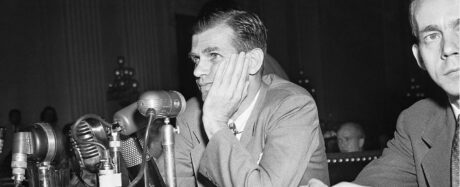
Hiss – a handsome liar
Did Alger Hiss – blue blooded State Department official and confirmed Soviet agent – bamboozle a sick President Roosevelt at the Yalta Conference and gift the South Kurile Islands (known as the Northern Territories in Japan) to Stalin, even though they had never belonged to Russia or the Soviet Union and had a settled Japanese population?
Was the Russian-speaking General who commanded the Japanese troops in the disastrous Battle of Nomonhan against the Red Army in 1939 actually a Soviet asset?
Read the book to find Brown’s considerations of these and many other fascinating topics. It is very well written, and he manages the difficult task of being thorough, balanced and entertaining with aplomb. The next volume is keenly awaited.