
Published in Nikkei Asia on October 2 2o25
What is the connection between shape-shifting rock musician David Bowie and Aritomo Yamagata, often called “the father of Japanese militarism”? The answer is gardens in Kyoto.
Twice chosen Japanese prime minister in the very late nineteenth century, Yamagata (1838-1922) was a low-born samurai who won power and wealth in the revolutionary turmoil that followed Meiji Restoration of 1868. Author Stephen Mansfield explains that the hardened nationalist was also a man of great taste who admired public and private gardens during visits to Britain. Hence “the spirit of modern openness” that permeates Murin-an, his garden in Kyoto.
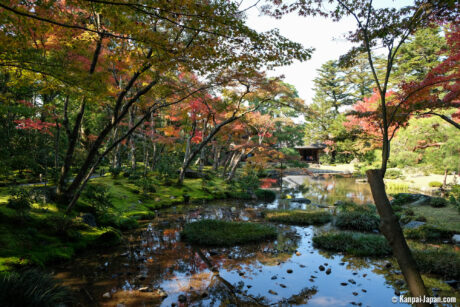
Murin-an
Bowie (1947-2016) was also of humble origins and as a teenager failed all his school examinations except art. He had a lifelong fascination with Japanese culture, including Kabuki, the works and persona of Yukio Mishima (1925-1970) and, we learn, gardens. Apparently, “Moss Garden,” a track from Bowie’s 1977 album “Heroes,” was inspired by a Japanese garden at Saihoji Temple in Kyoto. But a garden at Shodenji Temple, “an exquisite, little-visited dry landscape in north-west Kyoto” was the site he returned to repeatedly.
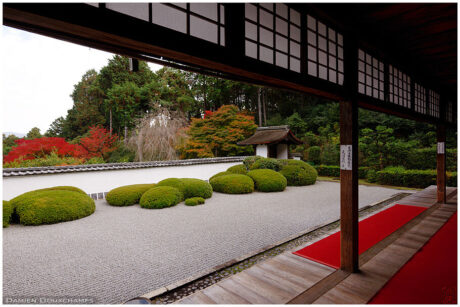
Shodenji- Bowie’s favourite
Perhaps it was there that the late musician was best able to experience “the deceleration of time and expansion of space” that the author considers a primary function of Japanese gardens.
Mansfield has clearly spent a lot of time thinking about Japanese gardens and the philosophy behind them. The book that results is a remarkable achievement. His enthusiasm and knowledge of the subject are palpable, and he has the gift of communicating them to those who know little, such as the writer of this review.
In fact, I was surprised to find that several fine gardens that feature in the book are within walking distance of my office in the Shibuya area of Tokyo; like all the others described they are also open to the public.
Entering the Kyu Asakura-tei in the trendy area of Daikanyama is like time traveling back to Japan’s Taisho era (1912-1926), when the country more or less avoided the First World War and silent movies and moga (modern gals) were all the rage. Despite being made of wood the house escaped damage from the 1923 Tokyo earthquake and the World War II fire-bombing that took place about 20 years later. This degree of survivability in today’s Tokyo, where 1990s buildings are regularly being knocked down, is astonishing.
Others, though, are less accessible, such as Mirei Shigemori’s aptly named Garden for Appreciating Clouds, which is to be found at an elevation of around 1,200 meters in the mountainous Kiso region. Much further south lies the lush vegetation of Shikina-en in Naha, the prefectural capital of Okinawa, once an independent kingdom. Fortunately, the book has many spectacular large-format photographs that successfully capture the mystique of the creations.
Mansfield divides his gardens into two categories — “The Gardens of the Entrepreneurs (1900 to 1945)” and “The Modern Mindscape: Design since 1945.” The pre-war entrepreneurs who chose to spend their money on gardens must have been a feisty lot, given the wild swings of the Japanese economy in the period. They included a maker of camera parts, a silent movie megastar who also appeared in early films by the legendary director Akira Kurosawa (1910 to 1998), and a wealthy rice merchant.
Many of the entrepreneurs’ gardens would not have survived the bombing in the Second World War — and neither would their fortunes –but Mansfield picks out eight notable examples that remain.
One is International House, formerly the property of the Mitsubishi zaibatsu (family-owned conglomerate), which is now a cultural exchange venue backed by The Rockefeller Foundation. According to the writer Robert Whiting, cultural exchanges in the fleshpots of the nearby Roppongi district have been much more lively, and arguably more significant, than the talking at International House. But the garden, designed in 1930 by Jihei Ogawa, who had worked for Yamagata in Kyoto, is inspiring in its own way.
For the post-war era, the author chooses some 30 gardens, the last of which was created in the current decade. Inevitably, these were not the fancies of wealthy individuals but the initiatives of luxury hotels, embassies, real estate companies and other institutions. Nonetheless, there is a refreshing adventurousness about many of the designs. Urban Japan has become increasingly high-rise in recent decades, resulting in rooftop gardens sited far off the ground. As with buildings, lack of space can be a spur to creativity.
If the book has a hero, it is surely the iconoclastic Shigemori. Overlapping the era of the entrepreneurs, he started his career as a landscape designer in 1939, having already excelled in painting, the tea ceremony and flower arrangement. He went on to create more than 180 gardens, six of which are featured in detail in the book, until his death in 1975. Shigemori’s boldness is startling. We learn from Mansfield that his 1953 garden for Kishiwada Castle in Osaka prefecture was intended to be viewed not just from the ground but from other perspectives, such as from planes and helicopters in flight.
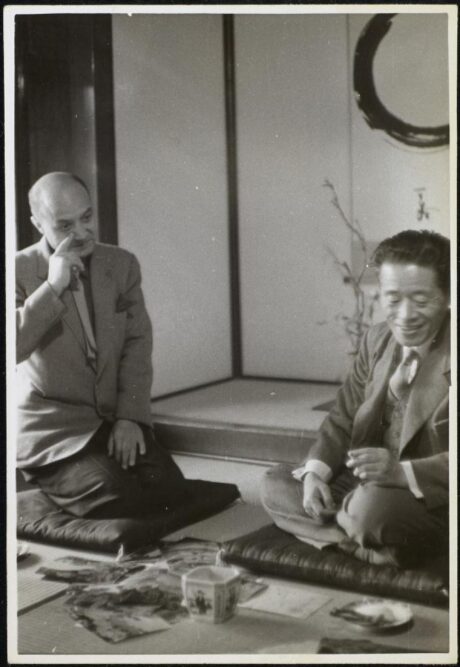
Mirei (right) with sculptor Isamu Noguchi
The Picasso of Japanese gardeners, Shigemori favored highly abstract, often dry formations and came up with the killer phrase “timeless modernity,” which neatly captures the essence of some Japanese traditional arts. A Noh dance-drama performance or the famous rock garden at Ryoanji Temple in Kyoto, said to have been created around 1500 by Tokuho Zenketsu, a Zen monk, would be classified as avant-garde if produced by a Western country in the 20th century. In Japan, they could be from almost any era. Hence the timelessness.
Although the book’s focus is the modern Japanese garden, there is a lot of history behind that title. Several of the designers quoted refer to the Sakutei-ki, an 11th century gardening manual. One of its instructions is to “obey the request of the stone,” alluding to the Japanese belief that all material objects have a spiritual nature. Unlike European gardens, Japanese gardens were originally linked to religious practices such as Buddhism, Taoism, Chinese geomancy and Shinto.
This remains the case today. Shunmyo Masuno, formerly the head priest of a Soto Zen temple in Yokohama, is a major figure in the world of garden design and features prominently in the book. The garden of the Cerulean Tower Tokyu Hotel, in the hurly-burly of Shibuya, is one of his signature works. Visible on many of his rocks are cracks and drill-marks from quarrying, yet he spends time listening to the “request of the stone” before setting his rocks in place.
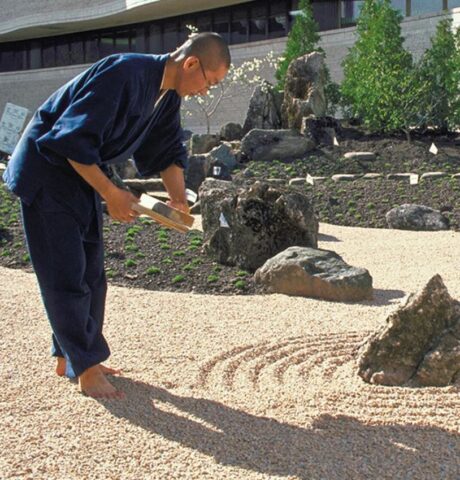
Masuno at work
Famed architect Kengo Kuma, who contributes an illuminating guest essay, puts it well. “Japan sacrificed its beautiful environment in exchange for economic growth. Only gardens can rescue us from the resulting desolate landscape that we now see before us. To revive the garden, we need a comprehensive global environmental discourse focused on gardens. For Japanese people a garden was never just a garden. It was always connected to the universe, and it taught us universal truths.”
Gardens could be fun too. In the Heian era (794-1185), garden streams were created for members of the nobility to entertain themselves by sending cups of sake down the waterways while composing linked verse. Life was short even for aristocrats in those days, but they knew how to enjoy it.
Other senses could be stimulated. Not only the perfume of the flowers but the soundscape of the garden could be part of the experience — either deliberately through the use of waterfalls, brooks and the clack of the bamboo deer-scarer or through the serendipity of insect chirps and temple bells. Needless to say, this would not work in downtown Tokyo and similar environments.
Garden designers appear as a surprisingly heterogeneous bunch, comprehending Zen priests, prize-winning architects and several foreigners working in Japan. Despite the Japanese-ness of this art that has endured over a millennium, there are signs of cross-culture interchange. Masuno has fulfilled many overseas commissions, and according to guest essayist Mira Locher, there is “an interest in Japanese gardens being constructed outside Japan as therapeutic landscapes connected to hospitals and prisons.”
Meanwhile, the traditional concept of the Japanese garden is challenged by a psychedelic installation built by Tadanori Yokoo on the art island of Teshima in Japan’s Inland Sea. Yokoo is a contemporary artist who made his name with wildly creative posters produced during Japan’s 1970s counterculture. As with all his productions, there is not a lot of wabi-sabi (austere simplicity) around, but the “trip” is worth taking.

Last but not least, there is the ubiquitous figure of Hiroshi Sugimoto and his Enoura Observatory project in Odawara, a seaside city about 80 kilometers southwest of central Tokyo. A jack of all artistic trades, he has prepared what he calls “archaeoastronomical structures” for the demise of civilization. We have been warned!