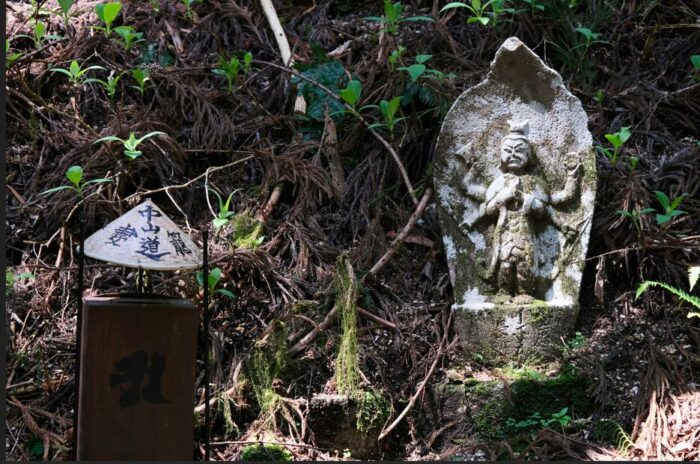
Published by Japan Forward on April 23
The British Museum’s recent Samurai exhibition turned out to be a disappointment. Fortunately, within Japan there are plenty of opportunities to appreciate the real thing. In many cases, Japan’s physical heritage has survived the years better in smaller and more remote communities than in the large population centres which were much more likely to be the targets of bombing campaigns and urban renewal.
In recent times, the tourist boom has had the beneficial effect of incentivising restoration work of an excellent standard. The evident civic pride is inspiring and – needless to say – there are no Disney products or “woke” gestures of the kind that marred the British Museum’s exhibition.
Highly recommended are the samurai estates in the small town of Kakunodate in Akita Prefecture and the two post towns of Tsumago and Magome in the mountaneous Kiso region above Nagoya. In order to enjoy the full experience, it is best to sample the local cuisine and try as many types of sake as possible.
In Kakunodate, there are six samurai residences open to the public. Located close to where the castle once was in the north of the town, they comprise the property of high ranking, medium ranking and low ranking samurai, distinguishable by the size and architecture of the dwelling.
In line with the strict demarcation of class devised by the Tokugawa Shogunate, farmers were only permitted to build single-story houses with thatched roofs, and they were not allowed to have front gates or entrance halls. Merchants lived in close-packed two-story buildings opened to the street and were restricted to the less posh southern part of town.
Earthen embankments separated the communities to prevent fires from spreading and to serve as a bulwark in the case of attack. Each dwelling in the samurai district has a front garden and is enclosed by a black wooden fence or hedgerow. The grounds of a high-ranking family might extend to the size of a football field.
The first samurai to settle in Kakunodate was the head of the Ishiguro family, who arrived in the early 1600s at the behest of superiors. Today too, there is an Ishiguro-san who plays an important role in the town. The estate was nothing special by the standards of Western aristocrats but in the world of samurai it conferred dignity and authority.
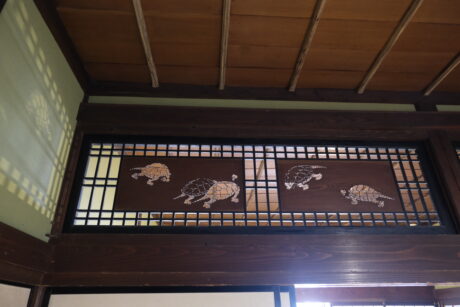
Ranma -a decorative panel that lets in air and light. Turtles symbolize wisdom and longevity.
Trees and a leafy garden gave privacy. The house has three entries – one for samurai, one for the lower classes and one for VIPs and occasions such as weddings. Guests would be seated in order of rank, with the most important the furthest from the door – and therefore least likely to be killed by an assailant.
Another clan, the Aoyagi, had a spectacular, highly decorated gate, a powerful symbol of their prestige. At the side of the gate are “warrior windows” (mushamado) that enabled the inhabitants to watch those outside without being seen. The entrance hall was made with deliberately low ceilings so that enemies would find it hard to brandish their swords. Latticed windows allowed the family to see guests before they entered the reception area, and there was a secret staircase to an upper room. You could never be too careful about your visitors.
Under the Tokugawa Shogunate which lasted from 1603 to 1868. Kakunodate’s samurai maintained their armoury of swords and muskets – many of which are on view today – but there was no large-scale warfare to keep them busy and, like samurai elsewhere, they turned to scientific and artistic pursuits.
The Ishiguro clan were noted for their knowledge of mathematics, astronomy and medicine but perhaps the Aoyagi were the most interesting group. Naotake Odano was a samurai from Kakunodate who had family ties with the Aoyagi. A talented artist, he specialized in “Akita ranga”, a drawing method influenced by Dutch art.
He is also well-known for illustrating the translation into Japanese of a Dutch book on anatomy published in 1774. Japanese physicians laboured for years to complete the translation. It followed the dissection of a corpse, which famously confirmed that the book of Dutch medicine contained accurate representations of human anatomy – and by extension that Western science was the key to Western power.
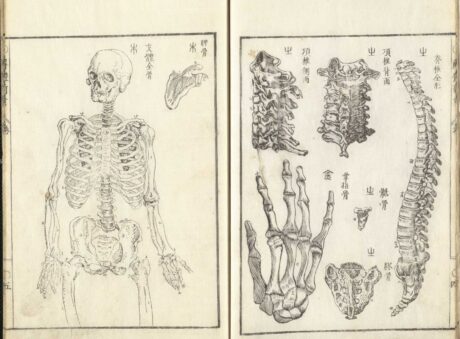
A page of Kaitai shincho, the book of anatomy illustrated by Naotake Odano
In an era of rigid hierarchies, Odano is said to have made the comment “all humans are equal when their bodies are dissected”. The gallery dedicated to him in the house is well worth viewing.
***
It is hard to believe that the Nakasendo, meaning “the central mountain route”, was once one of the two main arteries that linked Edo (now Tokyo) to Kyoto, the then capital city. Today, the population is sparse, though supplemented by Japanese and foreign tourists and hikers.
Most of the 540 kilometre path has disappeared into the mists of time, leaving the two staging-posts of Tsumago and Magome as the reminder of the area’s historic function. Tsumago in particular has been carefully restored and the hospitality is first rate, with welcoming Ryokans and fresh perch available from the ponds.
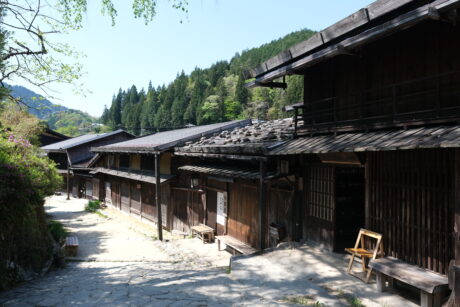
Tsumago on the Nakasendo route where Emperor Meiji stopped in 1880.
Back in the days of the Tokugawa Shogunate, a steady traffic flow was guaranteed. The alternate attendance system required the Daimyo (feudal lords) and their retinue of samurai to spend time in Edo, as well as in their own domains. Under the gaze of the Shogun and his spies, they would find it hard to hatch conspiracies against him and would be more likely to weaken their finances in the fleshpots of his city.
Once in a while, there would be a special event such as the funeral cortege of the lord of Owari being taken back to his domain in 1839. An escort of 1,670 men overflowed the Magome “Honjin” (a kind of official inn) and the 700 porters in regular service had to be increased by another 1,000.
The managers of the honjin did not have samurai status but as a reward for long service they were allowed to have a surname and carry a sword – privileges not open to ordinary people.
Even in times of peace, you should be on guard. Feudal lords brought their food with them in case of poisoning. In the Tsumago Honjin, there is an L-shaped room made purposely large so that enemies could not reach the important guests, even with long spears from the porch. The street is curved in a masugata style which prevents attackers from seeing the entire length of the town and forces them to slow down
The journey through the steep mountains and valleys was made deliberately difficult, with no wheeled transport allowed. The last thing the Shogun wanted was a large fast-moving military force coming his way.
The main business of the Kiso area, where Tsumago and Magome are located, was logging but you had to be sure you felled the right tree. The wood of five noble trees – the Japanese cypress, the Sawara cypress, the umbrella pine, the hiba and the nezuko – was reserved for the elites. The punishment for disobedience was decapitation.
Others walked the Nakasendo for different reasons. Basho went there to explore the natural beauty, and the country people raised a stone monument in his name. Woodblock master Hiroshige was probably seeking inspiration for his next project. Emperor Meiji used the route in 1880 as it was still a viable way to get from Kyoto to the city renamed Tokyo.
A good way to appreciate the disorienting changes that Japan experienced before and after the Meiji Restoration from the perspective of the Nakasendo is to read the historical novel “Before the Dawn” by Toson Shimazaki. Toson, a well-known writer who spent several years in France, was also the son of the man who ran the Magome Honjin in the 1860s.
Toson never knew his father, but the novel is a remarkable recreation of the era that brings in both great events, such as the coming of the black ships and the opening of Yokohama, and family tragedies.
Later in life, he returned to Magome and there is a small museum in his honour.
Half-story, half-historical record, the book deserves to be much better known outside Japan.
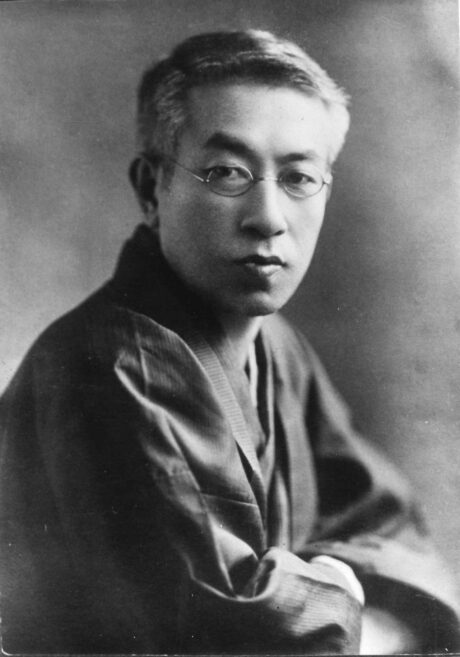
Author Shimazaki Toson
Excerpt If only the Black Ships had not come with people who would demand the opening of the country, by force if necessary. If only they had brought emissaries of peace and friendship instead, then those who lived here might have not have looked upon the visitors with such revulsion. We might even have had a history that included a warm welcome for them.
I don’t know about China or India, but if these visitors had come prepared to teach us about the true mutual responsibilities of nations, I am sure our people would have welcomed them. And we might very well have managed to avoid the shock and deceit and confusion that took place within our nation.
Unfortunately, the Europeans came to the people of this island as world conquerors. “To realize the mighty goal of the total conquest of all primitive conditions of nature through the invincible manifestation of the organized will of mankind –” this is what the Black Ships signified.