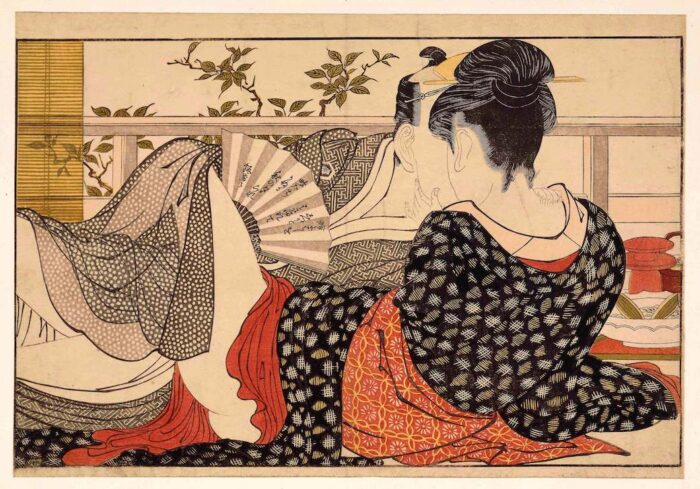
It didn’t look like the kind of place where you would find great treasures of Japanese art. We were in the backend of Kabuki-cho, one of the largest red-light districts in the country. All around were love hotels, pink salons, S&M clubs, girls’ bars and various other enterprises centring on human sexual activity.
In a sense, it was the right place for the exhibits, which were a collection of 130 Shunga (erotic pictures). The artists were the now world-famous Hokusai (1749-1864) and his pupils and the less well-known Eisen (1791-1848). According to scholar Emily Chase, about ten percent of Hokusai’s total output was Shunga.
The piece de resistance was Hokusai’s “Dream of the Fisherman’s Wife”, properly titled “The Diver and the Octopus.” We were lucky to see it as the picture not is often shown because of its fragility.
Apparently, when a print first made its way to late nineteen century Europe, it was thought to depict the horrific rape of a woman by monstrous sea creatures. To make the forced interspecies sex even worse, giant octopuses had an evil rap in the West, with Danish prelate Pontoppida amongst those accusing the Kraken, as they were called, of deliberately sinking ships.
Nobody could understand the Japanese text, and anyway there was little concept of female sexual pleasure in the era of “close your eyes and think of England”. In fact, the sexual relations are consensual, with the large octopus taking care of the lady’s lower body and the smaller creature, possibly his son, dealing with top half. From the cries the pearl-diver is emitting, she is enjoying the experience immensely.
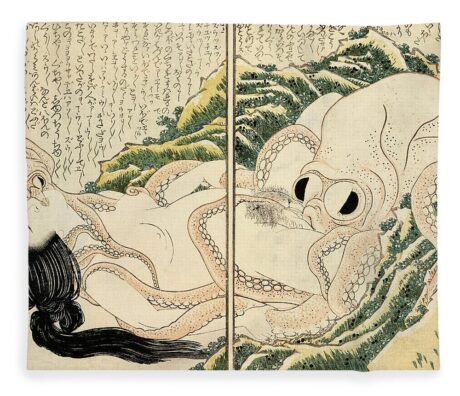
Partial view of Hokusai’s woodblock print, The Dream of the Fisherman’s Wife
The exhibition also shows a few other versions of the theme by earlier and later artists which are interesting but lack the verisimilitude of Hokusai’s work. Interestingly, the story goes way back to the Nihon Shokki of 720.
Eisen is more cartoony. He has a sleeping woman dreaming of an enormous phallus; a woman pleasuring herself with a harigata (dildo); a skinny, somewhat sad-looking chap using the male equivalent. You can see why Shunga were sometimes called “laughing pictures”.
The prints on display are the property of collector Mitsuru Uragami who helped with the British Museum’s comprehensive Shunga exhibition of 2013. Why has no large Japanese gallery or museum subsequently followed suit? It would be a multi-month sell-out for sure.
There is no longer any legal prohibition against the display of nudity and pubic hair for adults, but an unwritten code appears to be in operation, with the result that one of Japan’s cultural glories is rarely seen. I’ve heard that some women’s groups are militantly opposed to Shunga, yet when we visited many of the viewers were young women.
Under the Tokugawa Shogunate (1603-1868) there were periodic crackdowns on Shunga of varying intensity, and artists often used pseudonyms and codes to camouflage their identities. But the product still sold well. Emily Chase says there were even lending libraries which allowed you to borrow newly released Shunga.
Everything changed after the Meiji Restoration of 1868. Japan was busily making itself into a country of “civilization and enlightenment” like the European powers, and “obscene” practices like Shunga risked the charge of barbarism – which could be used to justify colonial-type treatment. Soon the sale and consumption of sexually explicit art was banned, with harsh penalties. Worse was to come when in the latter part of the Meiji era (c.1895-1905), the government began actively confiscating and destroying thousands of Shunga prints.
That all happened a long time ago but somehow history is casting a long shadow, which is why we are in Kabuki-cho – not in one of Tokyo’s glass and steel museums. Even now official Japan is dubious about the worth of Shunga, despite the approbation of Picasso, Toulouse-Lautrec, Klimt, Beardsley and many others.
The company which put the exhibition together is a Kabuki-cho fixture called Smappa Group. Their main business is running host clubs which are the inverse of hostess clubs and just as lucrative.
Clearly, Smappa have greater ambitions, reminding us that Kabuki-cho was so named because there were once plans to build a Kabuki theatre nearby. In attendance on the day we visited was Noriko Itasaka, Emeritus Professor at Senshu University and the academic advisor to the exhibition, giving a private tour of the exhibition.
The first room in which the exhibition took place was also a Noh stage, and Smappa have a quote from famed Noh performer Noboru Yasuda on their website
“When the world becomes heavy, stagnant, and closed off, it is laughter—sparked by eroticism—that has the power to break things open. Today, the world feels dark once again. Which is exactly why we need Shunga now. “
He may have a point there.
The exhibition continues until May 31st