
There are some fascinating points in this year’s survey of global wealth, as conducted by the Swiss bank, UBS. No surprises that Switzerland tops the list of countries in terms of wealth per adult again with $910, 382. Coming second is the United States which has average wealth of $696,277, a remarkable feat given the country’s large population.
Perhaps more eye-opening is the difference between the average and the median. Wealth is extraordinarily skewed in the US. Median wealth is just $68,998, which puts it in 28th place, lower than Slovenia and Portugal. If you were to adapt the “veil of ignorance”, as imagined by philosopher John Rawls, you probably would not choose to be borne in the US from a wealth point of view.
On the other hand, you might well choose to be an Australian. The “lucky country” has risen up the ranking to 5th place, with average wealth of $616,306. At the same time, the median wealth in Australia is $210,783, putting it at 3rd place. The Australian median is three times larger than the American!
In the rich countries, wealth is mostly financial and real estate-related, and it usually accumulates over time. But not always, as the collapse of the Japanese bubble economy and the South Korean wipeout of the late nineties prove. Could a similar phenomenon happen again to a major economy? Probably not at the same level of intensity but some highly valued stock markets could face a prolonged shakeout.
Indeed, some countries have already faced a diminution of average wealth over this decade. Notably, the UK and Holland have lost wealth per adult by -23% and -14% respectively. Conversely, Russia has done very well, with an increase in wealth of 37% so far this decade, despite the manifold sanctions imposed on their economy. Needless to say, the quality of the information may be significantly worse in non-OECD countries.
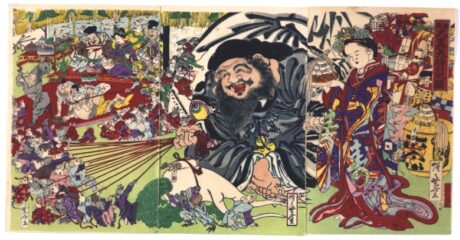
Daikokuten, the Japanese god of wealth – by Kawanabe Kyosai
Top of the class is South Korea with an amazing increase in average wealth of 63% since 2020. Japan came up with a much lower, but still respectable 10% increase over the decade to date. In terms of median wealth Japan blew the doors off with a 50% rise, which compares with South Korea’s 10%, making a neat mirror image.
Both South Korea and Japan are recovering from the financial disasters of several decades ago, which is why they have relatively lowly positions in the overall average ranking. Their economies are quite similar in many respects, but their corporate cultures are totally different. As a defeated country in WW2, Japan was required to remove the wealthy families that had run large conglomerates known as “zaibatsu”. The result was that “salaryman” managers took over and an interlocking shareholding system was constructed in which companies effectively governed themselves.
In contrast, the Korean “chaebols”, patterned on the earlier Japanese system, continued as before. The founding families remained in charge – and many still do. This history helps to explain the degrees of egalitarianism in the two countries, as well as their differing experiences of labour strife, which somehow seems to correlate with dynamism.
As it happens both countries are going through significant changes in the relationship between companies and investors. It may be that they become more similar. The Korean “chaebols” are being forced to be more transparent and mindful of their responsibilities to both small and large investors.
In the case of Japan, egalitarianism is by no means part of the national DNA. In the pre-war era, plutocrats and serial entrepreneurs, such as Eiichi Shibusawa, the man whose portrait is on Japan’s highest denomination banknote, were extraordinarily wealthy. In today’s Japan of private equity deals and the hunt for top talent, it would be no surprise if there were a mini revival of that trend, given that the “salaryman” culture is fading fast.
Both Japan and South Korea are in a much better place than ever before, having shaken off the effects of their twin financial disasters, and are likely to become significantly more wealthy in the years to come.