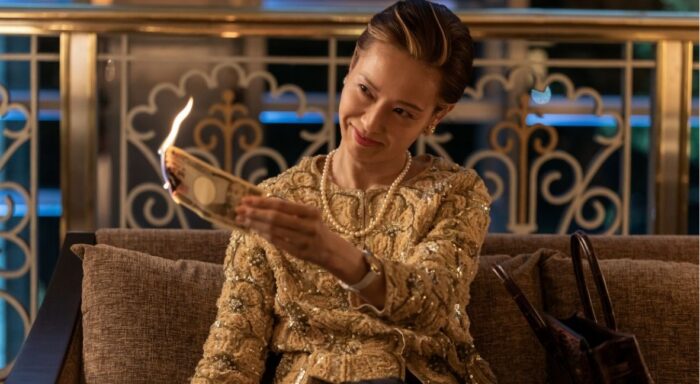
If she were still alive, astrologist and serial entrepreneur Kazuko Hosoki would be happy to learn that she had been featured in the World News section of Britain’s best-selling newspaper, the Sun. She would have probably also enjoyed the nine-part Netflix series that charts her story, despite the dark corners that are revealed.
A child of Japan’s lost war, she caught and ate earthworms amongst the rubble left from the American bombing. By the time she became mega-rich, she was quaffing Dom Perignon in host clubs and playing around with handsome males a third of her age. She wrote at least a hundred books but the real money came from private sessions for which she charged a hundred thousand yen and the sale of various pots and objects of supposed religious significance.
Her signature line, used on TV shows, was “you are going straight to hell”. It certainly packs a punch but in the world of astrology “hell” is metaphorical, something that you may have brought upon yourself.
Fortune-telling is not everyone’s cup of matcha. Some might call it a con, but it has survived in east and west through the ages. Like religion, it gives some kind of structure to our otherwise baffling sojourn on the planet. And it is a lot cheaper than a lifetime of psychoanalysis.

The young Hosoki at her own hostess bar
Hosoki was definitely an innovator. She created and patented the Six-Star astrological system in 1980, simplifying traditional Chinese methods to suit Japanese practises. As to the value of her predictions, she got the big one right.
In the late 1980s, Japan was going through one of the largest economic bubbles in world history. Hosoki repeatedly warned that the boom would end with a long multi-year bust. In astrological parlance, Japan would enter a national “daisakkai”, a period of great calamity.
That was right on the money, as Japan’s two lost decades confirmed. Totally wrong were the Bank of Japan, the Ministry of Finance, the big name foreign economists and “Japanologists” who believed that Japan had discovered a new capitalist paradigm, not to mention the large investment bank that forecast the Nikkei Index at one hundred thousand by the end of the 20TH Century. Thirty-six years later, that mark is still a long way off.
Hosoki won fame from her astrological work but in some ways her earlier life was more interesting. At least, that is the way Netflix paints it. She left school early and went through a bewildering series of make-overs.
Working at hostess club, she has a marriage proposal from a virginal young chap whose deceased Dad was a country landowner. Having barely managed to consummate the relationship, she learns that the old witch of a mother is planning to use her as breeding stock and then kick her out. Unfazed, Hosoki clears off pronto, first cooking the entire coop of hens.
Back in Tokyo, she opens her own club successfully but ends up penniless after falling head-over-heels for a smooth-talking trickster. Worse, the joint is taken over by a spectacularly nasty yakuza who rapes her on a regular basis.
Succour arrives when a good yakuza walks into the club. We know he is good because he is a handsome fellow and wears a hat that would make Alain Delon proud. Soon, the ugly brutish one is gone and Hosoki is in love again.
Undoubtedly, she had an extraordinary talent for publicity. The Japanese public were agog at the news that Hosoki had through sheer happenstance saved the life of Chiyoko Shimakura. The wildly popular singer of “enka” numbers (a genre as lachrymose as Country & Western) was massively in debt thanks to her ex-husband’s bad investments. Having decided to end it all, she was two steps away from jumping off a bridge until Hosoki appeared out of nowhere and persuaded her otherwise.
Subsequently, Hosoki took over Shimakura’s management and arranged an enormous schedule of gigs up and down the country. The thwarted suicide story was much too good to be true, but that’s show business. Did Ozzie Osborne really eat a live bat?
Another showbiz truism is that the talent gets ripped off by management. It happened to David Bowie, Leonard Cohen and many other smart people. In that respect, Hosoki probably conformed to industry practice.
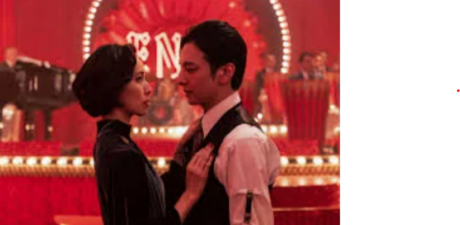
Hosoki with her “good” yakuza
Even so, the good-looking yakuza objected to the rough deal Shimakura was getting, being a long-time admirer of her music. He consoled her with a night of passion which revealed his superb tattoos and left Hosoki minus a boyfriend once more.
Needless to say, this is the story that Netflix chose to tell. Those particular participants are safely dead and will not be suing.
To its credit, the show reveals the complexity of the protagonist. She is abused and abuses, scams and is scammed. She is alienated from her siblings but takes flowers to her mother’s grave every year.
In conversation with the dry-as-dust journalist who is writing her biography, she claims she frequents the host clubs to take revenge on males. A few days later, she is proudly showing photos and paintings of the men in her life.
The real Hosoki was anything but a feminist, telling women to obey their husbands. Yet, she was a self-made woman who drove a white Rolls Royce and could sound like a yakuza boss herself. Consistency was not in her nature.
In later life, she lived in a huge apartment with the niece she adopted as a daughter. After her death in 2021, Kaori Hosoki took over the Six-Star divination system. She remembers Kazuko as “a slightly ditzy” grandma type with a charming side.
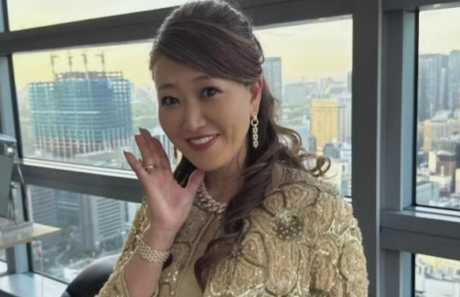
Kaori Hosoki defends her adoptive mother
That is hard to square with the Netflix portrayal but there is a “Rashomon” aspect to the legend of Kazuko Hosoki. As with the classic Kurosawa film, we don’t know what is false and what is true. Her alienated brother dishes the dirt on her – but he himself has been in trouble with the police on several occasions. Is he reliable?
In another instance, Kazuko meets an aged right-wing intellectual and marries him, much to the horror of his daughter. He has worsening dementia, but Hosoki feeds him booze and cigarettes. He soon dies and the daughter gets the marriage annulled.
It seems a straightforward case of exploitation, but the guru of the right was already rebelling against the strict regimen imposed by his tall, bony daughter. Being an intelligent man, he probably knew he was not long for this world and wanted some excitement. Hosoki probably gave him plenty.
She can be reckoned as one of the “monsters” (kaibutsu) of the post-war Showa era. Japanese monsters are not necessarily dangerous unless you get in their way. They never change and keep going until they drop. What they have in spades is “konjo”- guts.
Most of them are male but Yoko Ono and Madame Sukarno – once a hostess in Akasaka club and then a dictator’s wife – are still with us many decades after their famous husbands passed away.
Can Japan rear such a generation of remarkable monsters again?