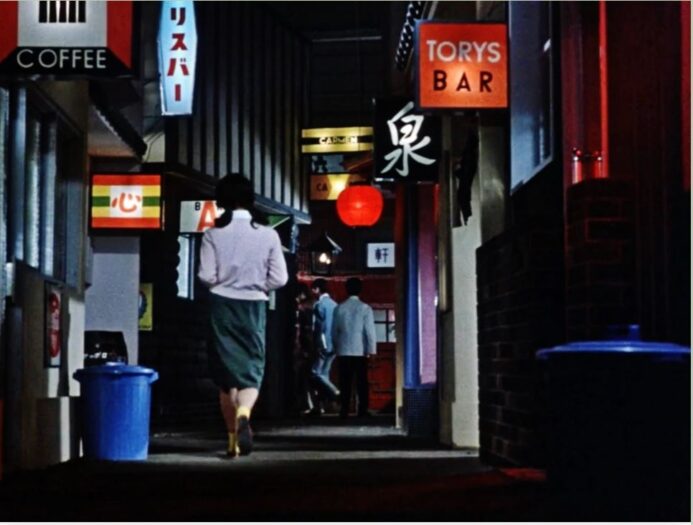
This summer I spent some time in a small town of fifteen hundred people in southwest France. As you might expect from the country that pioneered the art of cinema, it had a movie theatre. More surprising was the film that was screened, a 1933 silent classic called “I Was Born But…” directed by Yasujiro Ozu.
Watching “Les Deux Gosses de Tokyo”, as it is titled in French, made me consider the director’s remarkable range. In his later years, Ozu claimed that he was a “tofu maker” who would be incapable of producing any other kind of “cuisine”. That makes some kind of sense when applied to the films he made from the early 1950s onwards – family dramas in which emotions are carefully concealed, the camera is low on the ground, the action static for long periods, narrative ellipses provide the surprises and Chishu Ryu mumbles as only he can.
“I Was Born But…” is nothing like that. It is a comedy but a truly dark one, with political overtones. A family with two young boys is required to move from a comfortable home in the city to a new development on the advice of the father’s boss. They are bullied by their schoolmates and skip classes and eventually learn to bully others.
The boss is rich enough to own a movie camera and projector and gives a screening in his house. The two boys, peeping at the film, are horrified to see that their father, who they had respected as an important person, is in fact the company clown, making funny faces to entertain the higher-ups.
The two stage a strike, refusing to eat and throwing things around, causing the father to beat the older boy vigorously, possibly channelling the humiliations that he has undergone over the years. Ozu remade the story as “Good Morning” in 1959, complete with colour and fart jokes. It’s nothing like as powerful as the version made twenty years earlier.
“The Ozu Diaries”, a documentary film directed by Ozu specialist Daniel Raim, is essential viewing for anyone interested in great man’s work. It also tells us much about Ozu the man. Apparently, he was a mediocre student at school and had particular difficulties with mathematics, just like the boy struggling with his homework in “There Was A Father” (1942).
Like Kurosawa, he didn’t go to university. His parents were dubious about him entering the nascent movie business, which was considered a dodgy line of work, but he took to it like a duck to water, making several slapstick comedies influenced by Buster Keaton and Harold Lloyd in the 1920s. The ones I’ve seen are very good and the experience is greatly heightened if there is a benshi (live narrator) accompaniment.
Following the American precedent, he made some silent gangster movies as well, such as “Dragnet Girl” (1933), which traces the downfall of a bad man and his bad woman. Interestingly, he persevered with silent films into the late thirties even though talkies had become mainstream in Japan by then. He was both an innovator and a conservative.
“The Ozu Diaries” tells us that he felt more suited to polygamy than to marriage, and in his later years he lived with his mother, outliving her by just two years. There have been rumours of a long affair with a very famous leading actress, but Raim’s film does not go there. It does, however, comment on the amazing quantity of sake that Ozu and co-writer Kogo Noda guzzled while locked away for months working on scripts.
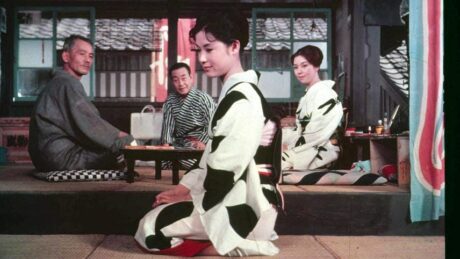
From “Floating Weeds”
In 1937, Ozu was drafted to the war against China as a member of a chemical warfare unit. The shock must have been tremendous for a man of his sensibility. One day he was gadding around Tokyo with beautiful film stars and geishas, then suddenly he was thrust into the front line of a brutal war. It is clear that he was desensitised, stating that corpses meant nothing to him and he hated the Chinese enemy. To put it another way, he had become a perfect soldier.
His brilliant young friend and rival film director Sadao Yamanaka was drafted some months later and sent to a distant area. Yamanaka’s letters describe the scenarios that he was planning for future films. But there were to be none because he was to die of disease in China, leaving behind a tiny handful of films. Among them, “Humanity and Paper Balloons” (1937) is an all-time classic.
Unlike many directors, including the young Kurosawa, Ozu was not required to make propaganda films. The films he did make in wartime were, like “There Was A Father”, bleak and hardly likely to raise morale. In his autobiography Kurosawa railed against the stupidity of the wartime Japanese censors who were about to dump his first ever film, “Sugata Sanshiro” (1943), on the grounds that it was too “British-American”. Fortunately, Ozu was on the panel as a professional expert and praised Kurosawa’s work to the skies and afterwards took this bright new talent out for celebratory drinks.
Ozu was tight-lipped about his own wartime experiences but the effect on his work was marked. The rawest and most straightforward example is “A Hen in the Wind” (1948), which features the most shocking scene in Ozu’s entire oeuvre.
A mother must nurse a seriously ill child without knowing whether her soldier husband will ever return home. The boy needs a special and very expensive medicine to cure him, and the mother is persuaded by a worldly friend to prostitute herself. The husband does come back and is enraged when she confesses what she did, to the extent of nearly killing her by throwing her down a steep staircase.
German movie director Wim Wenders, one of the film people whose comments enhance the documentary significantly, sees the wife’s pain-wracked climb back up the staircase as a metaphor for Japan’s total determination to recover from the disaster of war. The film does end with some kind of reconciliation, but the trauma remains deep.
In several others of the 1950s films there is a character missing, a son who never came back from the war. Indeed, the constant anxiety about marrying off adult daughters is partly a result of the gender imbalance caused by Japan’s huge losses.
Fittingly it is only in his last film that Ozu was able to extract some humour from the subject. In “An Autumn Afternoon” (1962) the Chishu Ryu character is in a neighbourhood bar and bumps into a cheery chap who was once under his command in the navy. Well-oiled by alcohol, they march around the tables saluting while other patrons imitate radio broadcasts announcing that all the ships have been sunk. The martial music is “The Battleship March”, commonly heard blaring out from pachinko parlours.
“Can you imagine if we won?” says the younger man. “We could be in New York right now. New York!”
Chishu Ryu smiles gently. “It’s a good thing we lost,” he says.
Ozu is often described as the most “Japanese” of the great directors, especially by foreign critics. This tendency has been debunked by literary scholar and prize-winning novelist Shigehiko Hasumi, who notes that in Ozu’s films it is nearly always as sunny as Southern California. “When it comes to seasonal sensibility and nature imagery, Akira Kurosawa and Kenji Mizoguchi are the more Japanese film makers by far”, he asserts.
In another broadside, Hasumi takes issue with critics who find Zen and haiku-like meanings in the famous scene in “Late Spring” (1949) when Chishu Ryu and his daughter sleep side-by-side in a ryokan in Kyoto. Ryu falls asleep and his daughter, soon to marry, dissolves in tears. Foreign critics have concentrated on the vase next to the daughter’s bed. What does this empty receptacle symbolise, they wonder. To Hasami, the vase is just a vase. Much more important is the shaking of the trees outside which mirrors the woman’s disturbed frame of mind.
Furthermore, Hasumi suggests that the relationship between the father and this daughter in her late twenties is semi- incestuous. No script item supports that conjecture, just the glowing eyes of Setsuko Hara.
All that being said, it would be a mistake to ignore the cultural roots of Ozu’s art. There could hardly be film titles more “Japanese” than “The Flavour of Green Tea over Rice” (1952) and “The Taste of Samma” which is the Japanese title of “An Autumn Afternoon” (1962), this particular kind of mackerel being a signifier of the coming of autumn.
“Bakushu”, the Japanese title of “Early Summer” (1951) is especially interesting. The literal meaning is “harvesting the barley”. But there are no farmers in the plot, which again, concerns the marital prospects of a 28-year old daughter. There is, though, a sheaf which has an important metaphorical function in the film – even though, in typical Ozu style, we never see it.
The daughter meets a widowed friend of her brother who had died in the war and wanted her to have it as a keepsake if he never came back. The widower promises to give it to her. The family have set up a suitable marriage with a well-heeled businessman but in a spur-of-the moment decision she decides to marry the widower. That means moving to Akita in the far north of Japan, so distant that it which might as well be another country, given the lack of high-speed trains at that time.
One family has fissured, another has been strengthened – and the circle of life goes on, as it must. That is the great theme of Ozu’s mature masterpieces. In the Diaries, he mentions rinne, the Buddhist concept of the recycling births until Nirvana is attained.
Patriarchs and matriarchs disappear, often surprisingly and off camera, and the world carries on without them. Ozu himself died an Ozu-esque death, passing away on his 60th birthday. His tomb is in a temple of the Rinzai zen sect in North Kamakura. There is no name on the grave but an engraving of the word “Mu” which means “no thing” or “beyond is and is not.”